Army veteran turns passion for making things into career path at Highlands College
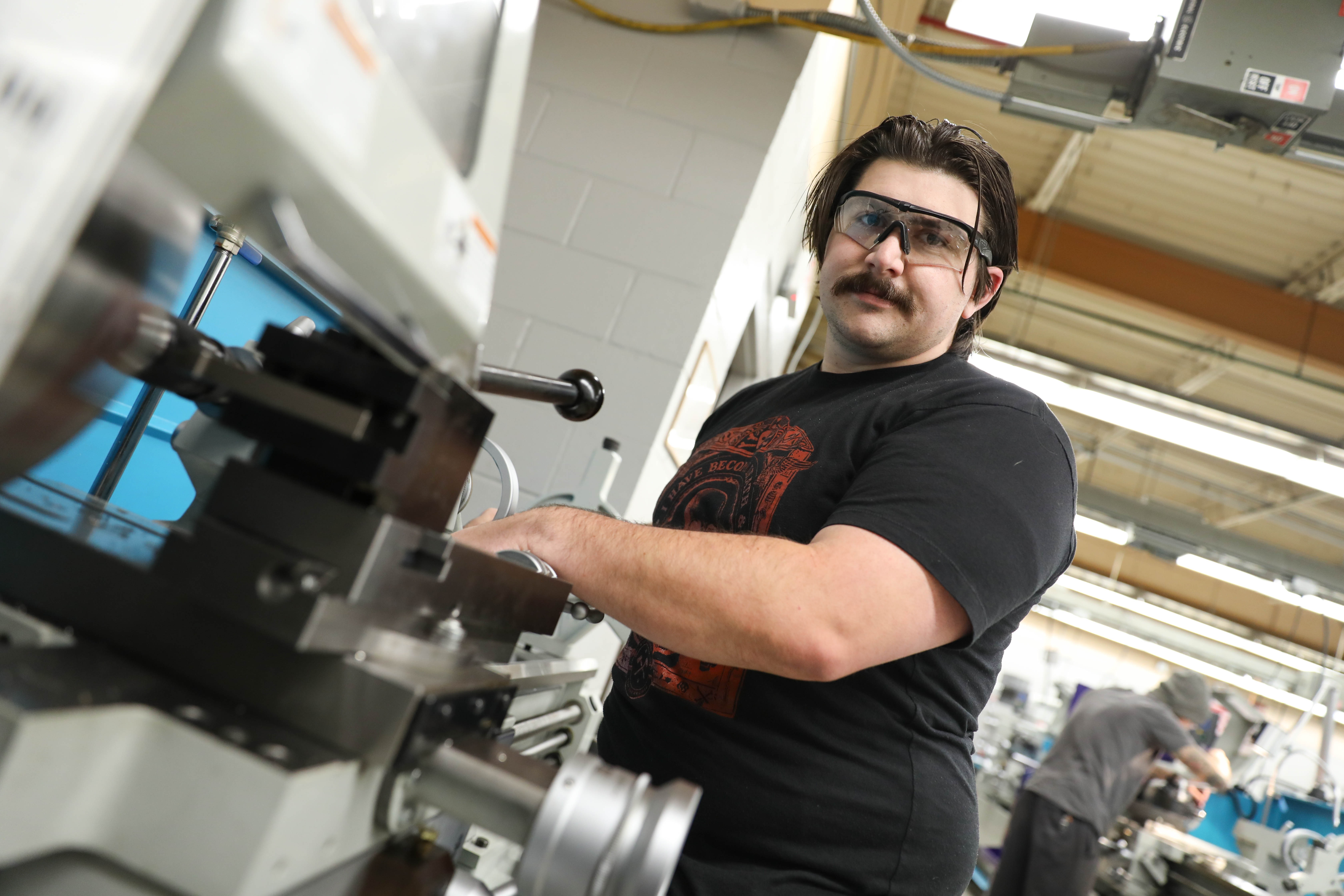
Highlands College student Brayten Torsak has always had an affinity for creation.
“I grew up making stuff, and I’ve always loved it,” Torsak said. “It's a level of satisfaction I don't
get from much else. I make my own furniture. I make my own tools. It's a great feeling.”
The Army veteran initially started down the mechanical engineering track, but as he studied he found he was paying for a lot of learning originating in a textbook he could have read on his own time. He wanted something more hands-on.
The precision machining program at Highlands College of Montana Tech offered everything he was looking for: immediate access to training using tools he would be hard-pressed to gain access to outside of a classroom environment.
“With machining, the equipment alone is prohibitively expensive unless you're actually in the industry, and it's something I wanted to learn,” Torsak said. “I'm a hands-on person, so tying myself to a desk would be not my thing.”
Now in his second year, Torsak has learned that precision machining requires much more than simply operating equipment.
Machinists use specialized equipment, including mills and lathes, to cut and shape materials into parts that meet exact specifications. Those parts can be found in everything from automobiles and industrial machinery to the tools and molds used to manufacture everyday products.
Torsak said one of the most surprising things he has learned is just how much modern manufacturing depends on machinists.
“I didn't fully comprehend till I was in it that everything in our modern world goes through machines at some point,” Torsak said. “Whether it be the molds that get injection molded for gummy worms, all the way through automotive equipment, anything you can think of, gets processed through these machines in one way or another.”
The work requires an extraordinary level of precision. Torsak said many of his early class projects required measurements within five-thousandths of an inch, approximately the thickness of a sheet of paper. As students advance, they begin working with tolerances as small as one tenthousandth of an inch.
Students receive technical drawings and must manufacture parts that meet the measurements and specifications outlined in the plans, much like they would in a professional machine shop. But knowing how to read a drawing and operate a machine is only part of the equation.
“I was surprised at how much of it is just learning to feel it out and understand how the metal interacts with the cutting tool,” Brayten said.
Experienced machinists learn to recognize subtle changes in the sounds and vibrations produced by their equipment. Those signals can indicate whether a cutting tool is moving too quickly, removing too much material or operating under the wrong conditions.
“There's audible and tangible feedback with machines, and you have to pay attention to that,”
Torsak said.
The work also requires patience. A single mistake can mean starting a project over from scratch.
“If you cut too much off, you can't put it back on,” Torsak said.
For Torsak, the most rewarding part of the program has been having access to equipment that allows him to create projects of his own.
Outside of his required coursework, he has used extra shop time to manufacture tools for his woodworking and other personal projects. One particularly elaborate project is a custom screwdriver featuring an integral keyhole bolster, a design typically associated with high-end custom knives.
His personal projects can take anywhere from two to 20 hours to complete, depending on their
complexity. The opportunity to create something from start to finish keeps him coming back to
the shop.
“I love academic learning, but where I really get my warm fuzzies is putting my hands on things and making stuff, and that's everything that the machining program's about,” Torsak said.
He also sees a promising future for students willing to develop the skills and patience the profession demands.
While automation and artificial intelligence are changing many industries, Torsak believes skilled machinists will continue to play an important role in manufacturing, particularly when it comes to setting up equipment, troubleshooting problems and producing specialized parts. He hopes to eventually combine his machining and woodworking skills in a career creating highend custom products. He is also interested in opportunities in defense and aerospace manufacturing, although he would prefer to remain in Butte, a community he and his wife have come to love.
For prospective students, especially veterans returning to school, Torsak encourages having a
clear goal and being willing to dedicate the time necessary to master the trade.
“The hard part about learning machining is having the patience to take the time and really learn it,” Torsak said. “You can read, you can learn a lot from that, but there’s the hands-on aspect that
can't really be taught. It has to be learned through experience.”
He hopes more people will begin to recognize the skilled work behind the products they use
every day.
“Most people don't know what a machinist is or anything about it because nobody talks about it,”
Torsak said. “Not very many people stop to think, 'I wonder how this thing was made?'”
For Torsak, knowing the answer — and having the skills to make it himself — is precisely what
makes machining so rewarding.