Air Force veteran finds new passion in precision machining at Highlands College
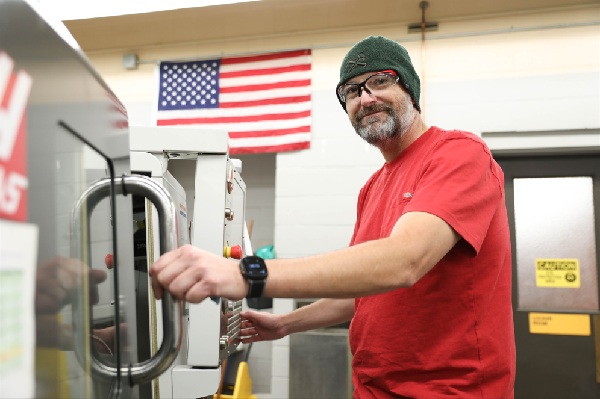
David Betka has always had an affinity for working with his hands, in fields where precision matters. The Air Force veteran spent more than 20 years in the military, including eight years as an aircraft mechanic before transitioning into an operational flying position.
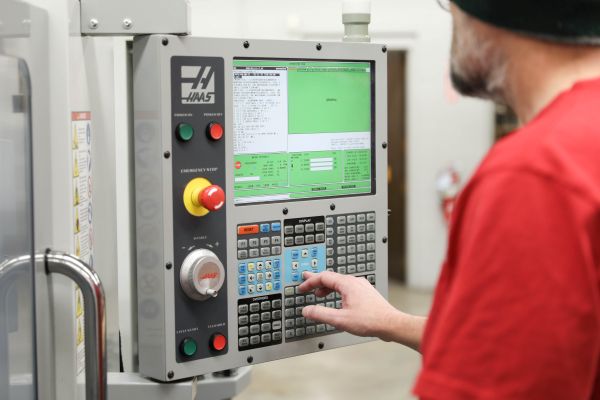
Now retired from the military, Betka is putting those skills to work in a new way as a precision machining technology student at Highlands College of Montana Technological University.
“I like working with metal, working with my hands, using tools,” Betka said. “That's kind of my passion. It’s something I've always been interested in.”
Betka, who now calls Butte home, grew up around mechanical work. His father was an aircraft mechanic for commercial airlines who frequently tackled home improvement projects himself. Betka learned many of his hands-on skills by watching and working alongside him.
That early interest eventually carried over into his military career, where attention to detail was essential.
“I like that it's precision,” Betka said. “Honestly, I'm kind of a math nerd, and I appreciate holding tolerances and specifications and stuff like that.”
Betka had dreamed of retiring in western Montana for nearly three decades. As his military career drew to a close, he began exploring opportunities that would allow him to pursue his interests while settling in the region.
He discovered Highlands College through Operation Next, a workforce training initiative offered through the Department of Defense's SkillBridge program. In fall 2024, he participated in weekend machining classes at Highlands College, gaining an introduction to the equipment and techniques used in the industry.
“I really enjoyed that program,” Betka said.
Still uncertain about his next chapter, Betka enrolled in mechanical engineering at Montana Tech, where he completed three semesters. While he enjoyed aspects of the program, he found himself missing the hands-on work that had initially drawn him to machining.
He decided to transfer to Highlands College and enroll full time in the precision machining technology program.
“That's the biggest thing I love about it, is we're in the shop every day,” Betka said. “We have class using tools, making parts. It’s definitely hands-on. There's a little bit of classroom lecture, but most of it's in the shop learning.”
As a first-year student, Betka is learning to operate both manual and computer numerical control (CNC) machines. His projects have included machining screw threads, bushings and other components that help students develop the skills needed to produce parts to exact specifications.
The introductory training he received through Operation Next has been especially valuable as he builds on those skills.
“Having that SkillBridge program that I did has been really helpful, just to have the knowledge, or kind of the foundation,” Betka said.
He also appreciates the individual attention students receive at Highlands College. His class has just seven students, allowing for one-on-one instruction and plenty of opportunities to work directly with equipment. Each first-year student has an assigned lathe, and students also have access to CNC machines and other specialized tools.
“I love the class size here,” Betka said. “That allows us to get a lot of one-on-one instruction if we need it.”
Betka said the quality of the equipment, instruction and welcoming campus atmosphere have made his experience especially rewarding.
“It's a very friendly college,” Betka said. “Everybody here is very helpful.”
While many students enter the program preparing for careers in manufacturing and machining, Betka's goals are a little different. After completing more than two decades of military service, he is enjoying the opportunity to learn something new without the pressure of pursuing a particular career.
He doesn't rule out working in a small machine shop that produces custom parts, but for now, he is focused on developing skills that support his personal interests.One of those interests is steam engines.
“I'm fascinated with steam engines,” Betka said. “I would like to someday eventually make a steam engine, whether it be a little one that sits on the table or all the way up to a small-scale steam locomotive.”
Building a functioning steam locomotive could take years, but Betka is intrigued by the mechanical complexity of the machines and the challenge of creating one himself.
For now, he is enjoying the process of learning.
Betka is using benefits through the U.S. Department of Veterans Affairs' Veteran Readiness and Employment program to pay for his education. He encourages other veterans to explore the educational benefits available to them, even if navigating the process can sometimes be challenging.
“Don't give up,” Betka said. “It's a great program. It's very helpful. I would definitely encourage them to explore and use their benefits for sure.”
He also hopes prospective students understand that machining requires more than an interest in working with tools. Attention to detail, mechanical aptitude, cleanliness and safety are all essential, and mastering the equipment involves a significant learning curve.
“I don't think it's easier,” Betka said, comparing the technical coursework at Highlands College with his previous engineering studies. “It's just a different skill set, really.”
For Betka, that different skill set is exactly what he was looking for.