Montana Tech researchers use data science to reduce risk in market trading strategy
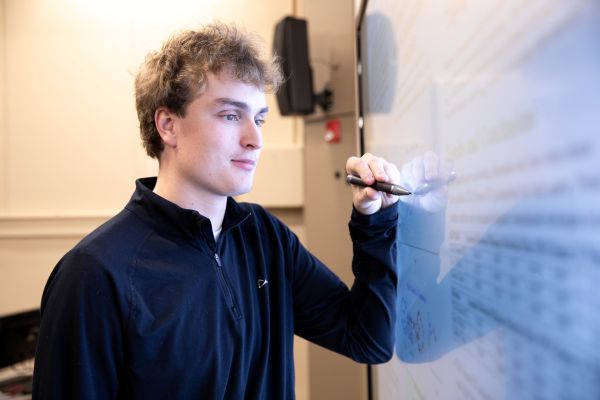
Trillions of dollars are traded across global financial markets every single day, and Montana Technological University researchers are crunching the numbers to create models that they believe could help investors risk less money while optimizing returns.
Data science senior Adam Moser recently presented the research to the American Mathematical Society (AMS) 2026 Fall Eastern Sectional Meeting at George Washington University in Washington, D.C., on October 3–4, 2026.
Moser, a Billings native, worked with Professor of Mathematics (Program Director of Data Science and Interim Chair of Computer Science) Dr. Atish Mitra and 2026 graduate Joe Opitz and other researchers outside Montana Tech on a project that applies topological data analysis (TDA) to a widely used stock market trading strategy known as the Golden Cross Death Cross.
The research grew out of a final project Moser and Opitz completed in Mitra’s TDA course. Mitra later asked the students if they wanted to expand the work into a full capstone project.
“We accepted that offer immediately because it was an amazing opportunity,” Moser said.
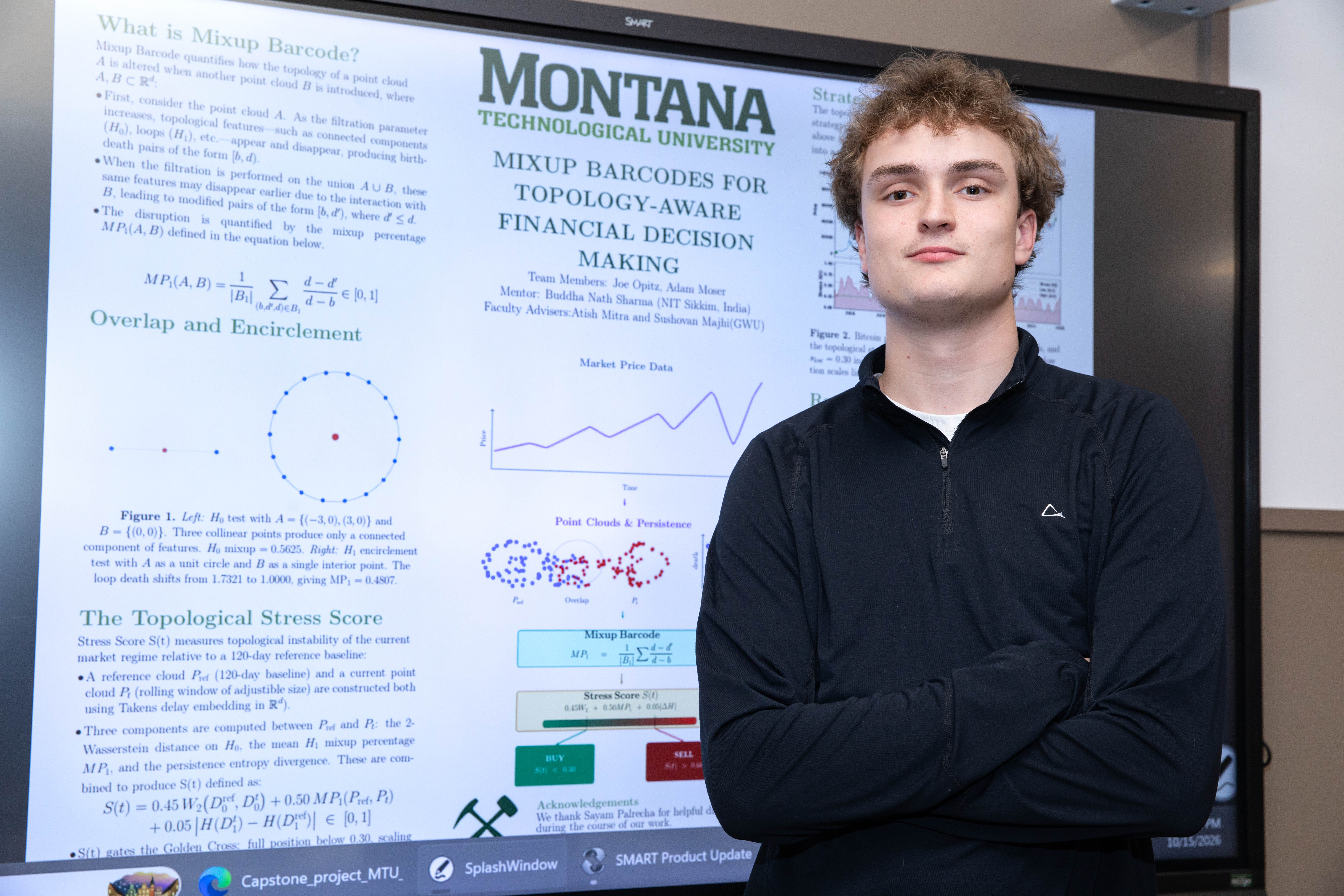
The Golden Cross–Death Cross strategy uses crossings between short-term and long-term moving averages as signals of potential shifts in financial market trends. The strategy is widely used and relatively simple, but the Montana Tech team wanted to see whether applying TDA — a branch of mathematics that can be used to identify patterns and structures in complex data — could improve its performance.
“What we wanted to improve was the risk,” Moser said.
The team tested its method using historical data from two very different markets: the S&P 500 and Bitcoin. They then compared the results with established trading strategies.
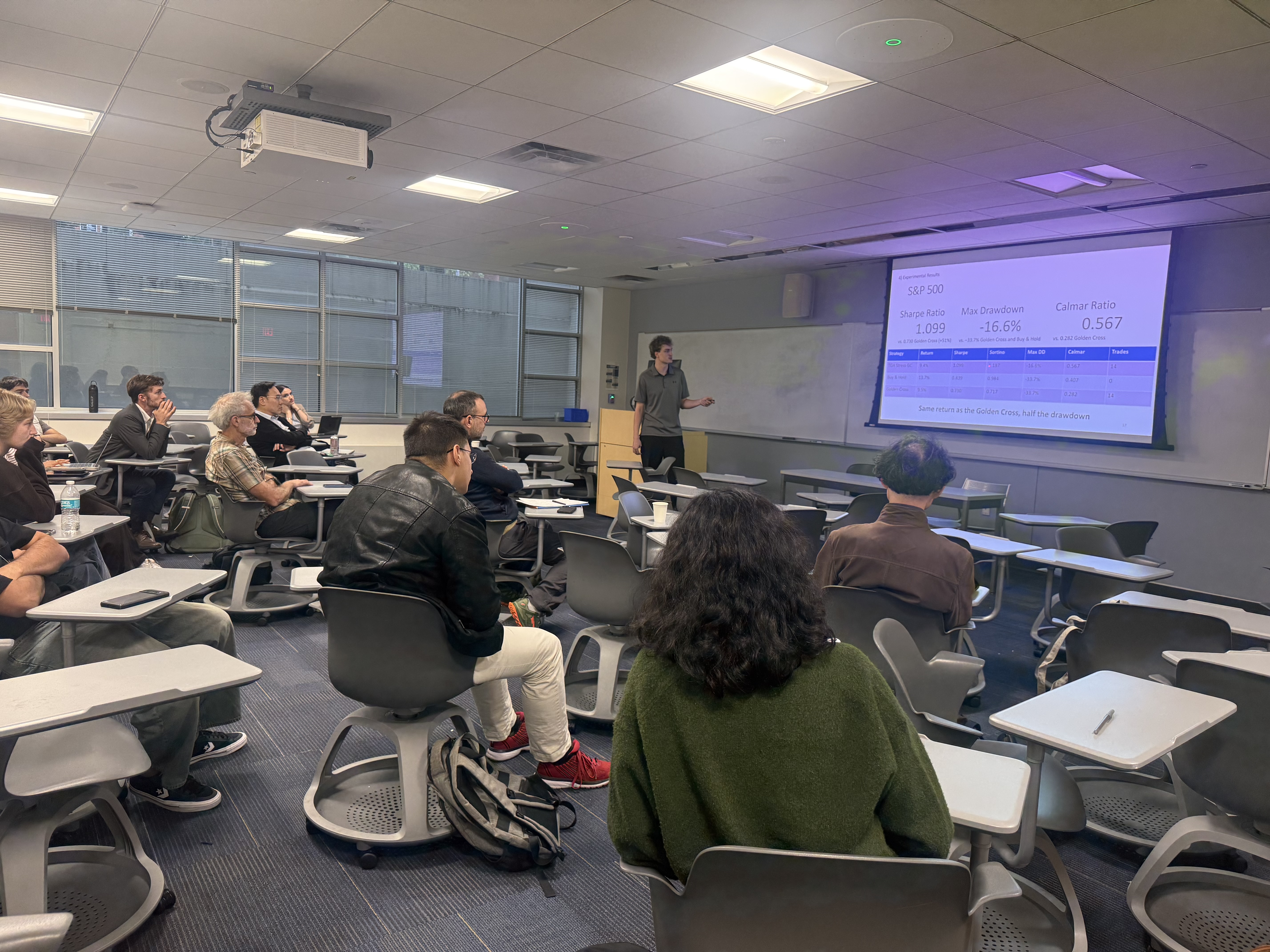
The results were promising. The Montana Tech team’s method produced an annual return comparable to the original Golden Cross Death Cross strategy while exposing an investor to about half as much risk.
“It made the same amount of money, but the amount we risked was half of what the original method risked,” Moser said. “So basically we don't have to pay as much to win the same amount.”
The model isn't a crystal ball for the stock market. So far, the team has used it to analyze historical data and identify periods when markets became unstable, including points when the model indicated an investor might have benefited from exiting or reentering the market.
The researchers have discussed whether the work could eventually be adapted to analyze live market data, but that remains a possibility rather than a current capability.
A manuscript detailing the research is available here and is in the process of being submitted to a peer-reviewed research journal.
Presenting the research in Washington also gave Moser something that couldn't be replicated in the classroom: feedback from mathematicians seeing the work for the first time.
One attendee asked whether the team had considered testing its method during a period when a simple buy-and-hold investment strategy performed poorly. The question immediately gave Moser another way to think about research he had spent a year developing.
“I worked on this project for a year, and this guy watched me present it for 15 minutes and totally made me rethink a part of it,” Moser said.
It was also Moser's first opportunity to present research in a professional setting outside the classroom.
“This was my first big, professional presentation outside of class, and it was kind of cool because of that,” Moser said.
Moser's interest in working with numbers started long before the project. He said math was his favorite subject growing up, and his father works in the insurance and mathematics field. That exposure introduced Moser to actuarial work as a potential career.
When choosing a major, data science offered the combination he was looking for.
“I chose data science because I like the statistics side of it, and the computer aspect as well,” Moser said. “It kind of combines the math and computer science into one major.”
Moser has already put those skills to work professionally. He initially landed a remote internship with a Dallas-based actuarial firm after searching online for opportunities. The internship turned into continued employment, and he has worked remotely for the company during the past two summers and throughout the school year.
After graduating in May 2027, Moser plans to begin working full time for the firm and pursue the professional examinations required to become an actuary. The company will pay for his study time and exam fees as he works toward certification.
For students who enjoy math but aren't sure where it could take them, Moser said persistence matters more than having everything figured out from the beginning.
“If you like it, you can overcome any of the challenges that come with it as long as you work hard at it,” Moser said.