Montana Tech, in collaboration with University of Alaska Anchorage, University Alaska Fairbanks and University of Wyoming, awarded $6 million NSF grant to advance critical mineral recovery
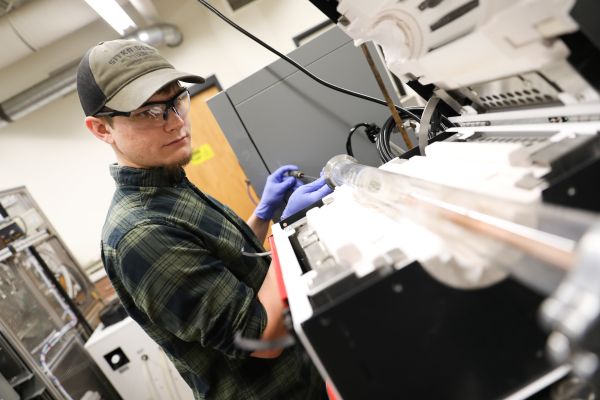
Montana Technological University, in collaboration with universities in Alaska and Wyoming, have received a $6 million National Science Foundation award to help develop new technologies that combine artificial intelligence and biological processes to recover critical minerals from domestic resources.
“This award reflects the kind of research Montana Tech is uniquely positioned to lead, Vice Chancellor for Research and Dean of the Graduate School Dr. Katie Hailer said. “This project brings together fundamental science, emerging technologies and applied engineering to address challenges of national importance. Developing new approaches to critical mineral recovery is essential to strengthening our domestic supply chains, and this collaboration will allow our faculty and students to help advance those technologies while building the workforce needed to carry them forward.”
The four-year award brings together researchers from the University of Alaska Anchorage, University of Alaska Fairbanks, Montana Tech and the University of Wyoming in collaborative research titled “Transformative Bioprocessing and AI-Driven Frameworks for Sustainable Critical Mineral Recovery.”
The project will establish a Smart Bio-Refinery framework featuring AI-enabled microbial recovery systems designed to help address the nation’s reliance on foreign sources of rare earth elements. Researchers will integrate expertise in environmental, metallurgical and process engineering, microbiology, mineralogy, and artificial intelligence to develop more sustainable methods of recovering critical minerals.
Dr. Robin Bullock, faculty in Environmental Engineering serves as principal investigator for Montana Tech’s portion of the project. Lewis S. Prater Professor of Metallurgical and Materials Engineering, Dr. Courtney Young, is the co-principal investigator. Montana Tech’s portion of the funding is $1.3 million.
“I am honored to work alongside Principal Investigators Dr. Brandon Briggs at the University of Alaska Anchorage and Dr. Srijan Aggarwal at the University of Alaska Fairbanks. Through partnerships like this, we can share expertise, maximize our resources, and secure early wins in the search for resilient critical mineral recovery while expanding workforce development opportunities,” Bullock said.
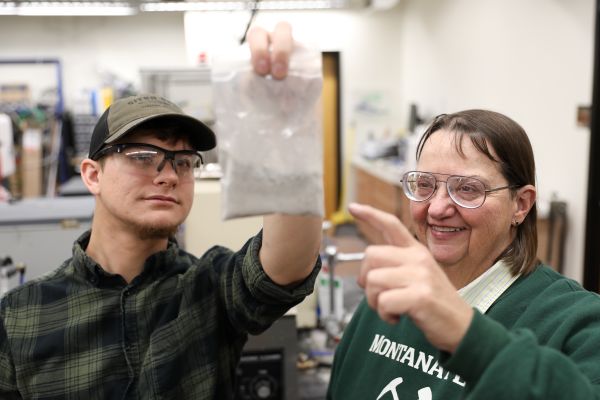
Researchers will develop scalable biological technologies to recover rare earth elements from coal refuse. Artificial intelligence will help identify materials with high recovery potential, while researchers will investigate how microorganisms can be used to extract valuable elements.
The project will pair that research with a Virtual and Field Pilot Plant, creating an initial digital environment where researchers can model and refine recovery processes before moving them forward into real-world applications. The project analysis will incorporate factors such as energy requirements, economic feasibility and environmental impacts to help researchers identify effective, lower-impact approaches to critical mineral recovery.
By combining these technologies, the researchers aim to create a predictive framework that could accelerate the development of domestic critical mineral resources while reducing dependence on foreign supplies. The work has implications for U.S. economic competitiveness, energy security and national security.
The collaboration will also strengthen research infrastructure and workforce development across the EPSCoR states of Alaska, Montana and Wyoming. Plans include industry-aligned course deployment, an early career leadership council and a Tri-State Field Course designed to provide training opportunities connected to the critical minerals industry.
The project is one of eight receiving a combined $39.9 million through NSF’s Established Program to Stimulate Competitive Research Infrastructure Improvement Program: Focused EPSCoR Collaborations. The fiscal year 2026 awards support research spanning critical mineral recovery, agriculture, artificial intelligence, biotechnology, environmental monitoring, coastal resilience, snow science, semiconductors and quantum materials.
Montana Tech’s award begins Sept. 1, 2026, and is expected to continue through Aug. 31, 2030.