Montana Tech students gain hands-on technical editing experience producing free book
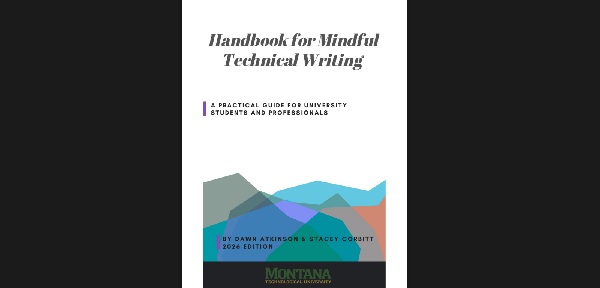
Lucid reports, standard operating procedures, and user manuals don’t happen by accident. Their production oftentimes involves technical editors, those folks with page design and writing prowess who use an eye for detail to shape complex material into a reader friendly form. During the Spring 2026 semester at Montana Technological University, a group of students developed this know-how while producing a technical writing handbook and making it freely available to peers, educators, and members of the public as an open educational resource (OER).
While completing Technical Editing, a course offered by Montana Tech’s Writing Program, mixed teams of graduate and undergraduate students created a style sheet for consistent page presentation, tailored content to fit a concise handbook format, and synthesized input from contributors to give the volume a cohesive voice. Student editors Frank Agyemang, Evan Guengerich, Ethan Heggem, Kyle Madill, Ahston McCray, Joseph McGreevey, Liam Mulcahy, Zainab Nasrullah, Patrick Renouard, Mehran Saddat, Karuna Sitaula, and Hilary VanVleet produced the book. Instructor Stacey Corbitt led the project-based class and walked learners through technical editing stages as they completed them in hands-on fashion and reported their progress to Writing Program Director Dawn Atkinson, a mock client who commissioned the handbook and provided feedback on the students’ efforts. Corbitt and Atkinson devised the project idea based on their experiences of developing textbooks and publishing them with Creative Commons licenses, copyright permissions that permit open resource sharing. Like the textbooks, the Technical Editing students’ handbook can be downloaded for free from the Open Textbook Library. The book will also be available on the OER Commons and the Montana Tech Library’s Digital Commons.
In addition to honing their technical editing capabilities, students who completed the experiential learning project built teamwork, presentation, communication, leadership, and accountability skills—competencies highly sought after in the modern workplace—and gained familiarity with accessibility standards for digital documents. The handbook represents a publication credit for the student editors, who are pursing various majors at Montana Tech, and one that they can list on their résumés. Montana Technological University’s writing faculty plan to begin using the handbook in classes in the fall, and Corbitt and Atkinson anticipate that its popularity will spread as it fills a unique niche among existing open educational resources.
Montana Technological University is a premier STEM-focused university in Butte, Montana. As Montana’s STEM university, Montana Tech offers transformational opportunities for all students through hands-on, applied, and experiential learning. Montana Tech has evolved into a dynamic institution which connects focused students to a network of people, opportunities, and experiences that empower them to change the world. Montana Tech offers world-class opportunities in science, technology, engineering, mathematics, healthcare, business, energy and the trades. For more information, go to www.mtech.edu.