From the fireline to a space grant: Alice Brummer lands summer aerospace internship
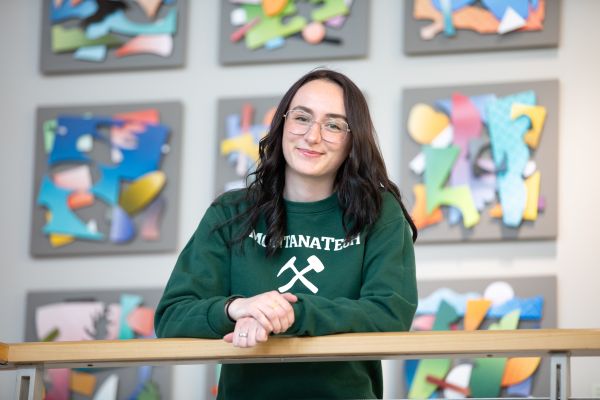
Alice Brummer didn’t expect a summer fighting wildfire would help launch her toward a NASA-related internship, but looking back, the connection feels almost inevitable.
A second-year computer science student at Montana Technological University, Brummer recently was awarded a Montana Space Grant Consortium Autonomous Aerial Systems Office internship, a competitive, paid opportunity that will place her in aerospace research focused on drone technology and wildfire applications. The Montana Space Grant Consortium was established in 1991 as a component of NASA's National Space Grant College and Fellowship Program.
“Words can’t describe how excited I am for this opportunity,” Brummer said.
The path to the internship began well before she ever applied.
Brummer, who grew up in Townsend, chose Montana Tech for its strong computer science program and hands-on learning environment. Inspired by her father, a computer scientist, she arrived on campus already interested in how technology works beyond the screen. She’s drawn more to hardware and systems than software alone.
That interest deepened after an unexpected experience the summer before college, when she signed up to work as a wildland firefighter.
“At the time, I thought it could be a career path for me, but afterwards, I realized I could combine my computer science knowledge with firefighting,” she said.
What she gained went far beyond a paycheck. On one fire, Brummer helped guide a division leader to a smaller blaze, an experience that demonstrated both awareness and leadership under pressure. At the time, she didn’t fully understand how that moment might shape her future.
“I have always been some kind of a leader,” she said. “But being around the firefighting environment showed me how important it is to make the right choices at the right times.”
At Montana Tech, a conversation with peers connected her to the Montana Space Grant Consortium, a program administered through Montana State University that provides students across the state with access to NASA-related research opportunities. Brummer applied, highlighting both her field experience in wildfire response and her academic background in computer science.
That combination stood out.
This summer, she will work on drone systems designed for wildfire environments, building controllers and contributing to technologies that can detect heat signatures, monitor conditions, and ultimately make firefighting safer and more efficient.
“I’ve always loved working with hardware systems, and I know I would excel” she said.
Her internship will begin in Missoula, where much of the research is currently based, with potential opportunities to continue work at NASA facilities in the future.
The work sits at the intersection of several rapidly evolving fields: aerospace engineering, environmental monitoring, and autonomous systems. For Brummer, it also connects directly back to the risks she saw firsthand on the fire line.
“It’s a super dangerous environment,” she said. “A lot of people are putting themselves into situations where quick thinking is very important.”
Her goal is to use technology to reduce that risk.
“My main goal is to be able to help other people by creating those drones to keep people safe,” she said.
In her coursework, she’s already beginning to build the technical foundation for that work. An embedded systems class has introduced her to circuits and microcontrollers, where she’s learning to program hardware components like sensors, lights, and signal systems, skills directly applicable to drone development.
“Using Raspberry Pis, we are converting analog into digital inputs,” she said. “Later on, I’ll be able to program a computer to tell a drone exactly what I want it to do.”
As drone technology advances, so does the need for secure, U.S.-developed systems. Brummer noted that recent shifts in policy have increased demand for domestically built drone controllers and software, opening new opportunities for engineers and computer scientists.
“It’s our job to create our own controllers for drones,” she said. “We’re always asking how we can modify and improve them.”
Though still early in her academic career, Brummer is beginning to see a clear direction for her future. It’s one that blends hands-on engineering with real-world impact.
“I have a good feeling this could be a career for me moving forward,” she said.
She also hopes her experience sends a message to others, especially women considering careers in STEM fields where they remain underrepresented.
“The only way that you’re going to be limited is if you limit yourself,” she said. “You can’t listen to the people who don’t know what you’re capable of.”
From a small-town classroom to wildfire lines and now to aerospace research, Brummer’s path has been anything but linear. But each step, planned or not, has contributed to where she stands now: on the edge of a career that could help reshape how technology supports those on the front lines of wildfires.