From Butte to Big Data: How one Montana Tech graduate is shaping the future of AI
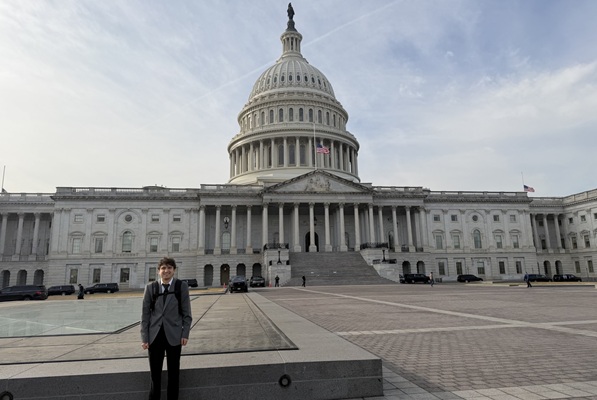
When Jacob Sriraman arrived at Montana Technological University from Missoula, he knew he liked math, but he wasn’t entirely sure where it would take him.
“I just declared a math major because I wasn’t super sure what I wanted to do,” Sriraman said.
That uncertainty didn’t last long.
Early coursework at Montana Tech introduced him to computer science and data science, where he discovered a new passion. Encouraged to explore coding and take foundational classes, Sriraman quickly realized he was drawn to the intersection of mathematics and computing.
“I noticed that I was drawn to the computer science side,” he said.
By the time he graduated in spring 2025, Sriraman had completed a double major in mathematics with a statistics option and data science. Today, he is continuing that journey as a Ph.D. student in computer science at Montana State University.
At Montana Tech, Sriraman didn’t just study concepts in the classroom, he applied them to real-world problems through hands-on research.
One of his first major projects explored with Dr. Atish Mitra was extreme winter weather patterns using an area of mathematics called topology.
“Using topology, we tried to understand what’s happening to the structure and the shape of the data as we move into these times of extreme weather,” Sriraman explained.
The project examined how data changes during events like polar vortexes and how it returns to normal afterward. The work became part of his capstone project and even led to a presentation at the Joint Mathematics Meetings, the largest mathematics conference in the United States.
For Sriraman, opportunities like this highlight what sets Montana Tech apart.
“People coming into Montana Tech have good opportunities,” he said.
While his early work focused on weather data, Sriraman’s most recent research moves into another rapidly evolving field: robotics.
Working with Montana Tech faculty and his current Ph.D. advisor, he is helping develop more efficient ways for robots to navigate complex environments.
“We are working on a robotic motion planning project,” he said.
The research focuses on how robots determine the best path through obstacles—something that becomes increasingly difficult as environments grow more complex.
“Existing methods for this are pretty computationally expensive, so we can narrow down our search to a smaller set of candidate paths,” he explained.
It’s the kind of work that has immediate, real-world applications, from autonomous vehicles to service robots. Sriraman says also its his favorite project so far.
As artificial intelligence and data-driven technologies continue to expand, Sriraman sees data science as one of the fastest-growing—and most dynamic—fields students can enter.
“AI is probably the most widely growing area,” he said.
But he’s quick to point out that success in the field requires adaptability.
“It’s moving really quickly. You’ve got to be willing to adapt and have generally applicable skills,” he said.
That mindset has guided his own path, from an uncertain first-year math major to a researcher working on cutting-edge problems in AI and robotics.
Looking back, Sriraman says one of the most rewarding parts of his journey has been discovering just how many different problems data science can solve.
“It allows us to work on more and more interesting problems and find applications in places we didn’t previously see them,” he said.
It’s a perspective that reflects both his experience at Montana Tech and the broader promise of the field itself: a world where curiosity, combined with the right tools, can open doors to unexpected and impactful careers.