Montana Technological University places second at Safety Olympics
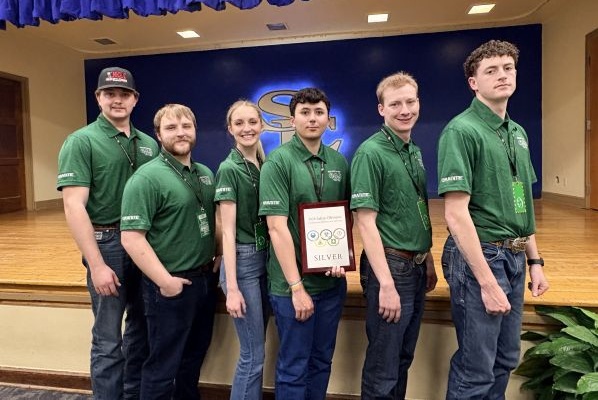
Students from Montana Technological University’s Department of Safety, Health and Industrial Hygiene took second place in a nail-biting finish decided by one-hundredth of a point at the Safety Olympics held Feb. 26-27 at Southeastern Oklahoma State University in Durant, Oklahoma.
The annual event requires participants to exhibit their skills in occupational health, safety, and industrial hygiene through a series of challenges. Montana Tech’s team consisted of Kaeden Daniels, Cooper Hofer, Morgan McClernan, Olivia Stillwagon, Layton Tucek, and Liamm Villasenor. The team was coached by Associate Professor Lorri Birkenbuel, Professor Dr. David Gilkey, and Professor Dr. Dan Autenrieth. Montana Tech competed against teams from Wisconsin–Whitewater, Central Missouri, Collin College, Oklahoma State, Pittsburg State, and the host institution.
“Southeastern Oklahoma State University put on an amazing event this year that was a significant improvement from previous years, especially with the addition of realistic, real-life scenario investigations,” Birkenbuel said. “The competition was tough, with impressive efforts from great teams and dedicated coaches throughout the event. I am extremely proud of our students’ performance and the hard work they put into preparing for the competition.Their commitment and professionalism truly showed.”
“I would also like to extend a sincere thank you to Granite Construction for sponsoring our team, and to David Sweeten for volunteering on our behalf, along with the rest of the judges who helped make the event a success,” Birkenbuel continued.
Events include Safety Jeopardy, which consists of a set of questions, based on the Associate Safety Professional exam, that must be answered in 60 minutes. The Hazard Recognition event requires teams to inspect a virtual workspace using virtual reality technology. Teams must identify hazards, find the OSHA standards associated with the hazards, and make recommendations for corrective actions in a set amount of time. The Safety Culture event requires students to present a boardroom-style presentation to convince management to implement their plan to change safety culture. The Incident Investigation event is a hands-on activity that requires the team to gather witness statements, evidence, and present findings to avoid repeated accidents in the future.
The Safety Innovation event is the one that students have been preparing for the longest. The competition requires students to complete a project addressing an innovative solution. This year’s team presented a project that proposed using biochar beneath home foundations to reduce the infiltration of radon- a naturally-occurring radioactive gas that is linked to lung cancer.
“My first Safety Olympics was an unforgettable experience,” occupational safety and health senior Kaden Daniels, of Columbus, said. “I really enjoyed how there were team events where all six of us competed and then events with teams of two. It was interesting to apply industry experience into a collaborative event with all my classmates. If anybody were to get the opportunity to compete in the Safety Olympics, I’d strongly suggest going.”