Ready to lead: Johannes Chandler finds community at Montana Tech
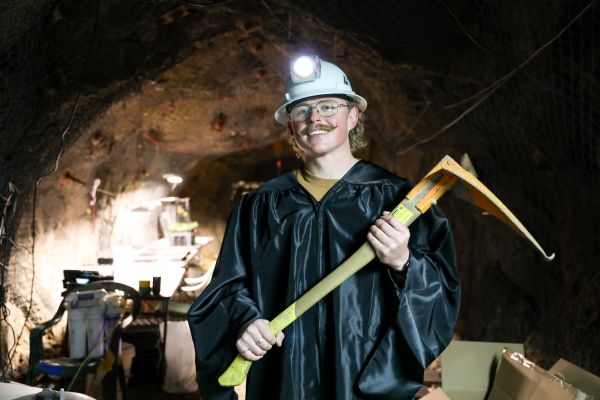
The world was disconnected when Johannes Chandler first arrived at Montana Tech as a freshman in the throes of the COVID-19 pandemic. It was the antithesis of everything Chandler had experienced up until then, growing up on a ranch in Absarokee, Montana, population 1,000. He was used to pitching in, talking to people face-to-face, doing business on a handshake, and having a strong sense of community.
“Starting college in 2020 was strange—you’re trying to meet people and build a community when everyone’s six feet apart,” Chandler said. “It made me realize how important community is. That’s what I discovered at Montana Tech.”
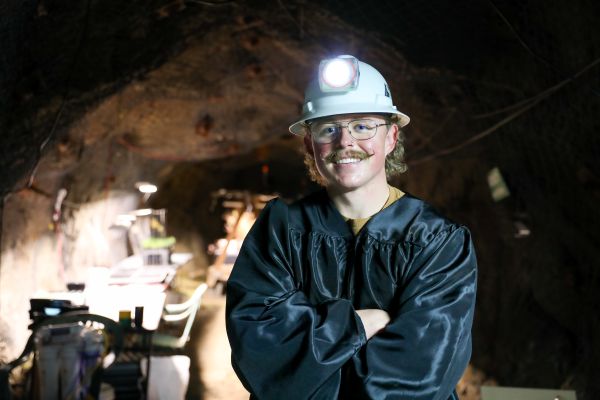
Five years later Chandler (B.S. Environmental Engineering, ’24) is preparing to walk across the stage to receive his M.S. in Environmental Engineering. His proudest accomplishment is not the growth he’s shown as an engineer; it is his development as a leader.
“I really found myself here,” Chandler said. “Montana Tech gave me the chance to step up, get involved, and grow—not just academically, but as a leader and a person.”
Chandler credits Montana Tech’s commitment to holding in-person classes as much as possible in the pandemic with a lot of his success.
“I honestly don’t know if I would have been able to continue in college if it wasn’t for having some in-person classes,” he said. “Once things opened up again, I really wanted to get involved and help others feel included.”
Chandler quickly became a familiar face on campus. He was personally invited by Chancellor Les Cook to serve as a Prospector student ambassador and as an orientation leader. Chandler took it as a call to lead.
“When I opened the letter from Chancellor Cook, I was honestly blown away,” Chandler said. “It’s not every day your university’s leader takes the time to write to you.”
Chandler excelled in the role.
“I really liked being a Prospector,” he said. “It was an honor to be part of that. I’ve made friends with people I’ve given tours to. It’s such an incredible opportunity for students who want to be leaders and be involved outside the classroom.”
In addition, Chandler welcomed new Orediggers as an orientation leader, founded the Environmental Health and Sustainability Club and served as president of the Environmental Engineering Club, helping to lead volunteer cleanups, speaker events, and hands-on learning projects. He also served as vice-president of the Backcountry Hunters and Anglers Club and later secretary of Fly-Fishing Club.
“Club leadership taught me a lot about communication, organization, and accountability,” he said. “You realize leadership isn’t about being in charge—it’s about showing up for people and helping them succeed.”
Chandler’s known he wanted to pursue a career in STEM from a very young age. His passion for problem-solving started in middle school, thanks to a teacher who challenged him to think critically and creatively.
“She definitely deserves a shout out,” he said of his science teacher, Catherine Frazer. “She was a great inspiration to a lot of students and taught very good science. I credit a lot of my scientific thinking and problem solving to her.”
A national engineering fair in Houston later broadened his perspective. There, Chandler heard a presentation about Engineers Without Borders—a global organization using engineering to improve lives in developing communities.
“They were working on projects all over the world, and I thought, ‘That’s something I really want to do,’” he said.
Chandler’s work so far has taken him to an environmental consulting firm in Idaho.
Chandler spent two summers interning with CDM Smith, an environmental consulting firm in Kellogg, Idaho, where he gained practical experience with mine waste remediation and project teamwork.
“My manager told me something that really stuck,” Chandler said. “He said, ‘Think about everything you did this summer and how you can do it better next summer. That’s engineering—always improving.’ That mindset helped me a lot, even with my master’s project.”
In graduate school, Chandler worked with Environmental Engineering Professor Robin Bullock on a project studying willows and their potential for phytoextraction—using plants to clean up and recover resources from contaminated soils.
“The willows ended up going better than planned,” he said. “It’s been a cool learning process. I found out way more about willows than I ever thought I would.”
The project also connected to his childhood. On his family’s ranch, the Chandlers had a tradition of collecting willow shoots around Easter to decorate, watch bud over time and eventually plant.
“From a young age, I knew that willows were extremely easy to propagate,” he said. “So when Robin brought up the idea, it was like a light popped on in my head—I’ve been propagating willows since I can remember.”
He played a big role in the re-development of Montana Tech’s underground greenhouse space in the Underground Mine Education Center, where students now conduct plant growth experiments. Chandler said the space is special, and he’s interested to see how the space will be used over time.
“There’s nowhere else in the country where there’s a mine on campus, let alone an underground greenhouse.” Chandler said. “Every new student that works down there brings a new set of eyes and finds something to improve—it just keeps getting better.”
Chandler’s college experience wasn’t without challenges. Managing ADHD while balancing rigorous coursework and outdoor interests tested his focus and time management.
“I have ADHD, and I really like the outdoors, and I’m social,” he said, laughing. “So being in Butte, where you have skiing, hiking, fishing, and hunting—it was hard to focus on school sometimes.”
A turning point came when he connected with Montana Tech’s Disability Services through the Academic Center for Excellence (ACE).
“I didn’t do it for the first two years, but someone suggested I go talk to them,” he said. “They really helped me—extra time on tests made a huge difference. It’s so easy to get help here, and professors are really supportive. Once I asked for help, I thought, ‘Why hadn’t I done this before?’”
That experience deepened his empathy as a leader. “It made me realize everyone learns differently,” Chandler said. “Good leaders understand that and try to make things work for others.”
After graduation, Chandler hopes to stay close to his roots, working in environmental consulting or mining in the Northern Rockies.
“I really like this area,” he said. “I like to hunt, fish, and ski—and we still have the family ranch in Absarokee, so being close to that as my parents get older is important to me.”
This winter, he’ll return to the slopes as a ski instructor at Discovery Ski Area—a job he’s held throughout college.
“It kind of forces me to go ski every weekend,” he said with a grin. “I have to go to work.”
Wherever he goes next, Chandler plans to keep growing—and helping others do the same.