From Ghana to Butte: Montana Tech graduate student pioneers research in rare earth magnet recycling
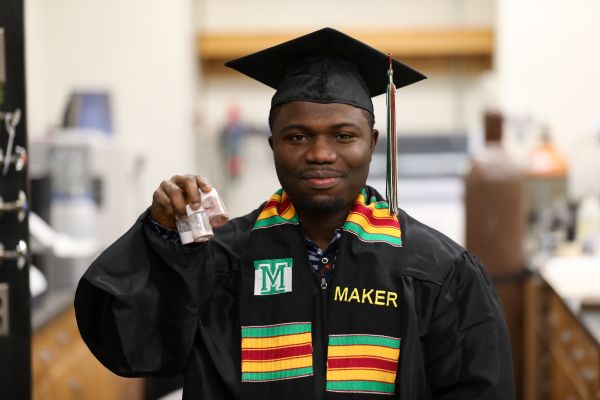
When Isaac Joseph Cobbinah sets out to learn something, he likes to focus on it intently, and stick with it until he feels like he thoroughly knows the subject.
That’s why he plans to put his knowledge on rare earth permanent magnet recycling to work in the metallurgical lab for a few years after he walks across the stage at Montana Technological University’s commencement ceremony on December 13 with a Master of Science in Metallurgical/Minerals Processing Engineering.
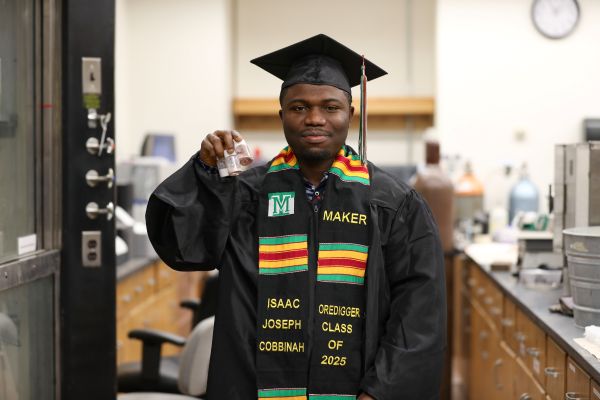
“I want to apply what I’ve learned before continuing my studies,” Cobbinah said.
When Cobbinah left his hometown of Tarkwa, Ghana—a region known for its gold mines—he couldn’t have imagined he’d one day find himself in a lab in Butte, Montana, studying how to recycle REE permanent magnets vital to the world’s most advanced technologies.
Cobbinah came to Butte to work under Lewis S. Prater Distinguished Professor Dr. Courtney Young. His research focuses on recovering critical rare earth elements from end-of-life neodymium iron boron magnets—materials essential in everything from smartphones and airplane engines to electric vehicles.
“I have a strong passion for chemistry and hydrometallurgy,” Cobbinah said. “Mineral processing is all about chemistry. I wanted to find a novel and cheap method of recovery critical rare earth element, especially those that support high-tech industries.”
Before coming to Montana Tech, Cobbinah studied at the University of Mines and Technology in Ghana, where he earned his bachelor’s degree in Mineral Engineering and worked as a research and teaching assistant and senior lab technician. His interest in complex-gold ores processing challenges led him to seek collaboration with experts abroad where he got a lot of solutions after taken courses like “processing of precious metals and flotation” during his master’s classes
“I found Professor Young listed as one of the top mineral processing professors,” he said. “I reached out, applied, and was accepted. That’s how my journey to Montana Tech began.”
Since arriving two years ago, Cobbinah has taught undergraduate mineral processing labs for two consecutive semesters, conducted extensive research on REEs, and even found time to play soccer with friends three time in a week. His work, however, addresses a problem far bigger than campus life: the United States’ reliance on China for critical REEs for permanent magnet production.
“China is known to be the main source of rare earths, but the U.S. doesn’t have many reserves and primary resources,” he explained. “That’s why we’re studying how to recycle permanent magnets and recover these critical REEs. It’s a way to bridge the gap.”
His thesis, Recycling NdFeB Magnets I: Production of REE Fluorides by A Novel LPC Process, explores hydrometallurgical methods for extracting valuable elements from magnets that have reached the end of their lifespan. These magnets are crucial components in modern technology, yet the materials they’re made from are scarce and difficult to produce.
“Without magnets, engines, computers, and phones wouldn’t function,” Cobbinah said. “So, finding a way to recycle them in the US is very important.”
Adjusting to Montana’s climate, however, wasn’t as easy as adjusting to its research opportunities.
“The hardest part was adapting to the weather,” he said with a laugh. “I learned about the three-layer dressing strategy, and I had to save enough money to purchase a car so I could get around. That helped a lot.”
Despite the cold, Cobbinah describes Butte as a nice place and says he’s grateful for the community he’s found on campus. He credits his success to supportive mentors and a hands-on learning environment.
“At Montana Tech, you own your work,” he said. “You learn how to use advanced equipment like SEM, EDS, and XRF, and you do almost all of the analysis yourself. That experience will really help me in my career.”
Dr. Young has great hopes for Cobbinah’s future.
“Isaac Joseph is very determined,” Young said. “He struggled at first with a different school and community but settled in quickly. It was smooth sailing afterward. Soon enough, he was getting data from his research and figured out how to optimize the results. I love it when students have that ‘ah-ha’ moment and become independent. He will do well. The company that is lucky to land him will get a dedicated and hardworking engineer. “
Cobbinah is proud of how far he’s come—and excited for what’s next.
“I’m proud to be a Montana Tech alumnus,” he said. “This research area is new, and very few people are studying it. It feels good to be part of something that matters.”
For students who hope to follow in his footsteps, Cobbinah offers simple advice: find the right mentor and follow your passion.
“Graduate school is all about your advisor and your determination,” he said. “If you love what you do and you have the right support, you can succeed anywhere.”