From emergency runs to final exams: the double life of a Montana Tech student
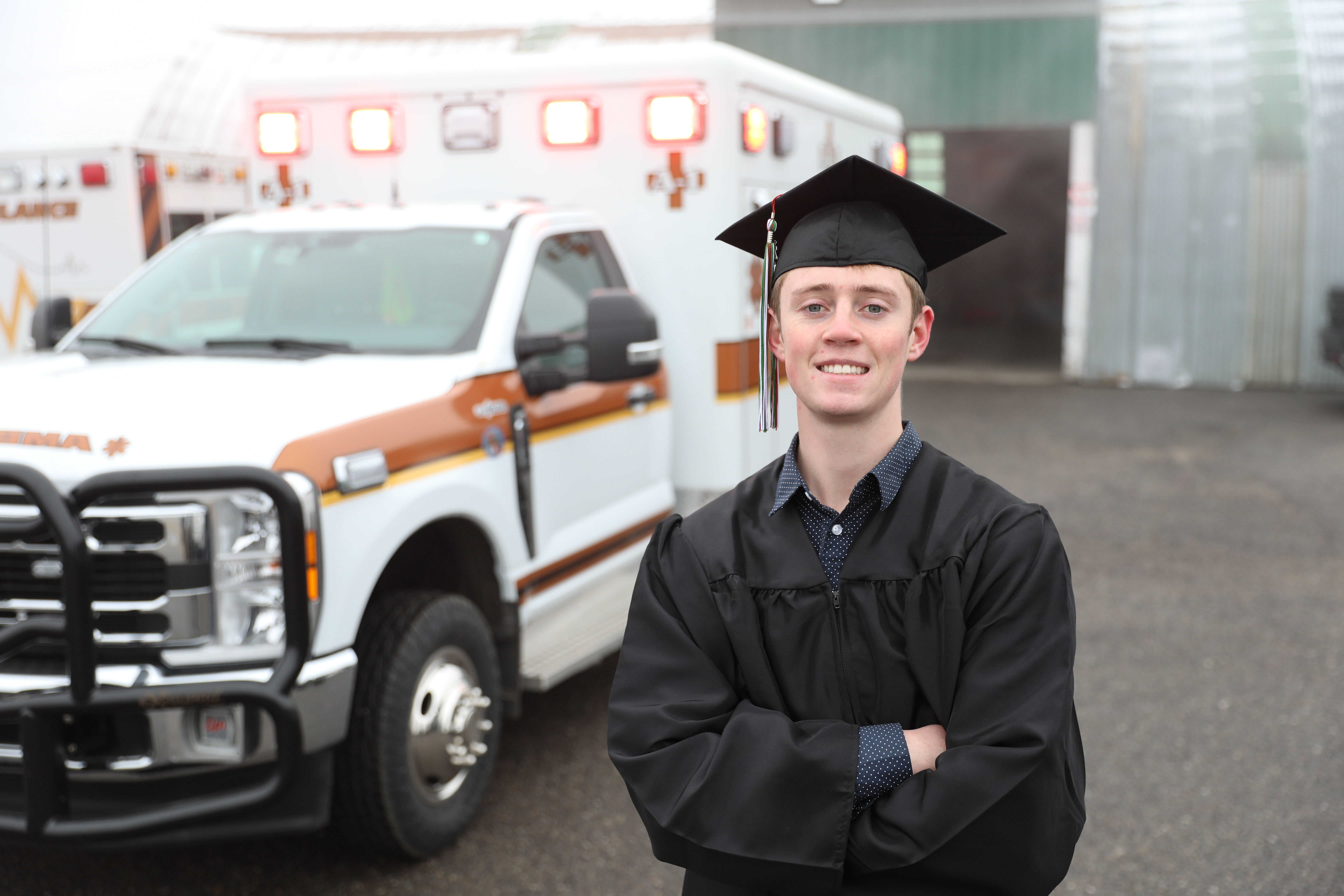
When most of Butte is asleep, Trey Whitlock is wide awake—watching the road flash by in the glow of red and blue lights.
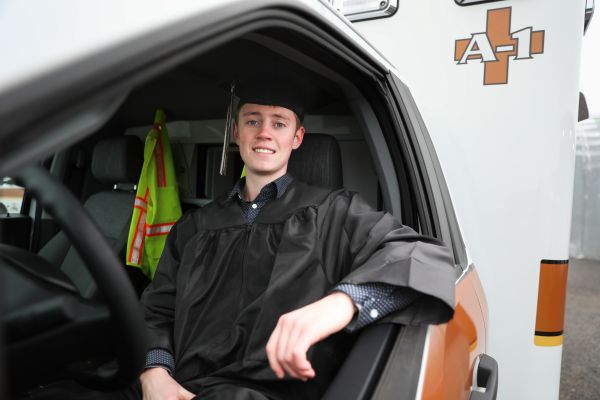
As an EMT with A1 Ambulance, the Montana Technological University senior spends his nights responding to calls across the Mining City—car wrecks, chest pains, slips on the ice, moments when seconds matter.
“You never know what the night’s going to bring,” Whitlock said. “One minute you’re laughing with your partner, and the next you’re helping someone through the worst day of their life. You just have to be ready.”
Whitlock’s calm under pressure has been forged through long hours and a deep love of both medicine and his community. Whitlock will cross the graduation stage at Commencement on Saturday, December 13, 2025 as he earns his Bachelor of Science in Biological Sciences, a degree he earned while working full-time on the ambulance, and attending paramedic school through the University of Montana.
“This semester, I’ve been taking about 28 credits total between the two schools while working 40 to 48 hours a week,” Whitlock said. “Some nights are hard, but it’s easy to show up to a job you really love.”
A high school anatomy class—and later, Montana Tech’s EMT course—helped Whitlock realize his curiosity about how the human body could translate into a career helping others.
“It was kind of a slow process of getting sucked in,” he said. “Once I started doing ride-alongs and saw how much of an impact you could make, I knew this was where I was meant to be.”
That calling extends to the classroom, where Whitlock’s senior research project explored VO₂ max testing in student-athletes. Under the guidance of Instructor Andrew Traut, Whitlock studied aerobic fitness, blending his love for athletics with science and medicine.
Outside the lab, he serves as president of Montana Tech’s Pre-Professional Health Club, organizing events that connect students with the community—including lively science demos at local elementary school.
“Kids go crazy for the elephant toothpaste experiment,” Whitlock said, smiling. “It’s so fun to see their excitement for science.”
Whitlock also volunteers as a coach for youth wrestling teams in Butte in what spare time he has, extending his enthusiasm for the sport to the next generation after years of competing himself.
After graduation, Whitlock plans to complete his paramedic certification and apply to physician assistant programs. He’s shadowed with several physician assistants in Butte, and even got to sit in on some orthopedic procedures during the process. He has long-term hopes of working in trauma or emergency medicine, with plans to apply to programs at large universities like Penn State.
“I’ve always been drawn to the fast-paced stuff—ER, trauma, ICU,” he said. “That’s where I want to be.”
Whether it’s a late-night call or a long day in classes, Whitlock sees every challenge as preparation for what’s next.
“Working on the ambulance teaches you how to stay calm and think fast,” he said. “It’s something I’ll carry with me wherever I go.”
Whitlock says his biggest supporters are his close-knit family.
“They’ve seen me pull some pretty long weeks between shifts and classes, but they’ve always had my back,” Whitlock said. “I think that’s part of why I’ve been able to stick it out.”
Wherever he goes Whitlock is confident Montana Tech and his more than 1,500 hours on the ambulance prepared him for the future.
“Montana Tech does a great job of preparing you for what the job is actually like, not just the textbook version,” he said.