From Ecuador to Yellowstone: Montana Tech Ph.D. student explores ancient clues to life through hot springs research
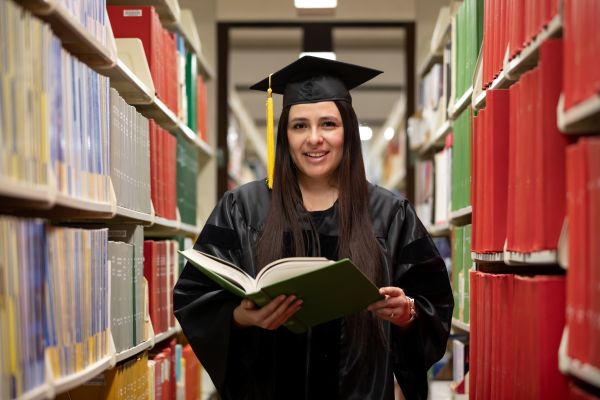
When most people visit Yellowstone National Park, they stop to marvel at geysers or photograph steaming pools from boardwalks. But for Eva Andrade Barahona, those same hot springs are a window into Earth’s distant past—and the foundation of a five-year scientific journey that took her from Ecuador to Montana Technological University.
Andrade Barahona, who will graduate December 13, 2025 with a Ph.D. in Earth Science and Engineering, studies how microbes in Yellowstone’s hydrothermal systems take up metals like copper, iron, and zinc. Her work—conducted in collaboration with Montana Tech Professor Dr. Alysia Cox—helps scientists understand how microorganisms adapted billions of years ago when oxygen first began accumulating in Earth’s atmosphere.
“I analyze how fast microbes take up metals like iron or copper as oxygen levels increase,” Andrade Barahona explained. “It helps us understand how early life might have evolved when the planet’s atmosphere changed.”
Her research stands out because there’s almost nothing like it in the world. Most microbial metal uptake studies focus on oceans or laboratory cultures—not on-site experiments in hot springs. Andrade Barahona’s work required designing field incubations directly in Yellowstone’s restricted research zones.
“There’s really no data to compare it with,” she said. “It was hard sometimes, but also exciting, because it means we’re doing something new.”
That curiosity—and courage to take on the unknown—has shaped Andrade Barahona’s journey since her undergraduate days in Ecuador. She grew up loving math and science, but research careers were rare where she lived. When a new university focused on scientific research opened, she knew she’d found her path.
“The program was all in English after the second year,” she said. “At first, I didn’t understand much English. The slides, the textbooks—everything was in English. But I worked hard which helped to improve.”
While still an undergraduate, she met Cox, who was teaching in Ecuador during a sabbatical. The two stayed in touch, and when Andrade Barahona began looking for a Ph.D. program, the connection led her to Montana Tech.
“What really helped me decide to come was that Alysia does research in Yellowstone,” Andrade Barahona said. “I thought, ‘if I can do research in a place most people never get to go, I’m in.’”
Since arriving in Butte in 2020, she’s presented her work at international conferences in Hawaii, France, and Prague. Each trip, she said, has opened doors—introducing her to new collaborators and perspectives.
“I was proud to represent the university,” she said.
Her journey hasn’t been easy. Starting a Ph.D. in a new country during the pandemic meant adapting to American systems—taxes, health insurance, and a culture far from home—while keeping up with demanding coursework.
“The hardest part was adjusting to everything new and trying not to fail,” she said. “I barely took time off the first two years. It was just work, classes, and research.”
But through perseverance and support—from her advisor, friends, and family in Ecuador—she found balance. Her parents, who encouraged her from the beginning, will travel to Montana this December, along with her siblings, to celebrate her graduation.
“They were always supportive,” she said. “Even when I told them I wanted to study far from home, they said, ‘Whatever you want to do, we’re with you.’”
Andrade Barahona says she hopes to stay in Montana after graduation, but wherever her next step takes her, Yellowstone National Park will always hold a special place in her heart.
“I still remember the first time I stepped into one of the sites in Yellowstone where the public isn’t allowed,” she said. “It was so beautiful. I thought, ‘this is why I came here.’”
Reflecting on five years of work, she’s proud of what she’s accomplished—and grateful for every challenge along the way.
“The journey, the research, the people I’ve met—it’s all been worth it 100%.”